You don't need to learn Cornish to have a good week in Cornwall. The person behind the counter in Padstow will not test you. But two or three words, used naturally, do something that a guidebook can't: they turn a transaction into a conversation, and they show you've noticed where you are. This is a small, honest starter kit — enough to greet someone, thank them, say goodbye, and read the landscape around you with a bit more understanding.
What you're dealing with
Cornish (Kernewek) is a Celtic language and a close cousin of Welsh and Breton. It fell out of everyday use in the 1700s and was brought back into speech from the early twentieth century onwards; today it has official recognition as a minority language and appears on signs, street names, school badges, pint glasses and car stickers across the county.
One thing to know before you start: Cornish has more than one spelling system and more than one pronunciation tradition. You will see Kernewek and Kernûak, Dydh da and Dedh da. Neither is a mistake. Different revivals made different choices. Pick the version you meet first and don't lose sleep over the rest.
Pronunciation: three things that matter
- dh is the sound in this, not thin. So Dydh da starts with a soft, buzzing "d".
- Stress usually lands on the second-to-last syllable — ker-NEH-wek, LOW-en. You'll hear variation between speakers, and that's normal.
- gh is a throaty sound, a bit like the end of Scottish loch. If it defeats you, a plain "g" is understood perfectly well.
Cornish is spelled far more consistently than English, so once you've got those three points, you can have a decent go at almost anything you read aloud. Nobody will mind if you get it wrong. Locals are far more likely to be pleased you tried than to correct you.
Twenty words and phrases worth knowing
- Dydh da (deeth dah) — hello, good day. The safest all-purpose greeting, morning to night.
- Myttin da (MIT-in dah) — good morning.
- Gorthugher da (gor-THOO-her dah) — good evening.
- Fatla genes? (FAT-lah GEN-ess) — how are you? To one person you know.
- Fatla genowgh? (FAT-lah ge-NOH) — how are you? To a group, or politely.
- Da lowr (dah LOWR) — fine, all right. The standard reply to the question above.
- Meur ras (mer RAHSS) — thank you. The phrase you'll use most.
- Mar pleg (mar PLEG) — please.
- Ya (yah) — yes.
- Na (nah) — no.
- Dyw genes (dee-oo GEN-ess) — goodbye, to one person.
- Dyw genowgh (dee-oo ge-NOH) — goodbye, to a group.
- Nos da (noss dah) — good night.
- Dha weles (dhah WEL-ess) — see you. Literally "your seeing"; casual and warm.
- Onen hag oll (ON-en hag OLL) — one and all. Cornwall's motto, and a fine thing to say in a toast.
- Kernow (KER-now) — Cornwall.
- Kernewek (ker-NEH-wek) — the Cornish language; also the adjective "Cornish".
- Lowen (LOW-en) — happy, glad. You'll see it on signs and hear it at festivals.
- Heb mar (heb MAR) — of course, without doubt.
- An gwella (an GWEL-ah) — the best.
You will also hear dreckly everywhere. It is Cornish English, from "directly", not Cornish itself, and it means something between "soon" and "at some point, possibly". Learn to enjoy it rather than fight it.
Reading the map: place-name words
Cornwall's place names are the language's best survival. Once you know a dozen building blocks, road signs stop being noise and start telling you what the land does.
- Tre- — homestead, farm, settlement. Trelawny, Tregony, Trewartha.
- Pen- — head, top, end. Penzance, often explained as "holy head"; Pendennis, Penryn.
- Pol- — pool, creek, cove. Polzeath, Polperro, Polruan.
- Porth- — harbour, landing place, gateway. Porthtowan, Porthcurno.
- Lan- — church site, enclosed holy ground. Lanhydrock, Lanivet.
- Nans- — valley. Nanstallon, and the newer Nansledan at Newquay.
- Men- — stone. Men-an-Tol, the holed stone near Morvah.
- Chy- — house. Chynoweth, "new house", a name that recurs all over the county.
- Carn- — rocky hill, pile of stones. Carn Brea, Carnkie.
- Wheal- — mine working. Wheal Jane, Wheal Coates.
- Bos- — dwelling. Boscawen, Boskednan.
- Ros- — promontory, moorland. Roscarrock, Roskilly.
- Hen- — old. Hendra, "old farm", appears on dozens of signposts.
Treat this as a reading aid rather than a dictionary. Place-name meanings are argued over by scholars, spellings drifted over centuries, and some names are part English, part Cornish, part guesswork. The pleasure is in noticing the pattern, not in being right.
Two moments where a word or two does the work
In a shop or café
Dydh da as you walk in. Meur ras when you pay. Dyw genes as you leave. That is the whole exchange, and it is plenty. You are not expected to conduct the rest of the conversation in Cornish, and nobody will be offended if the reply comes back in English.
On a footpath sign
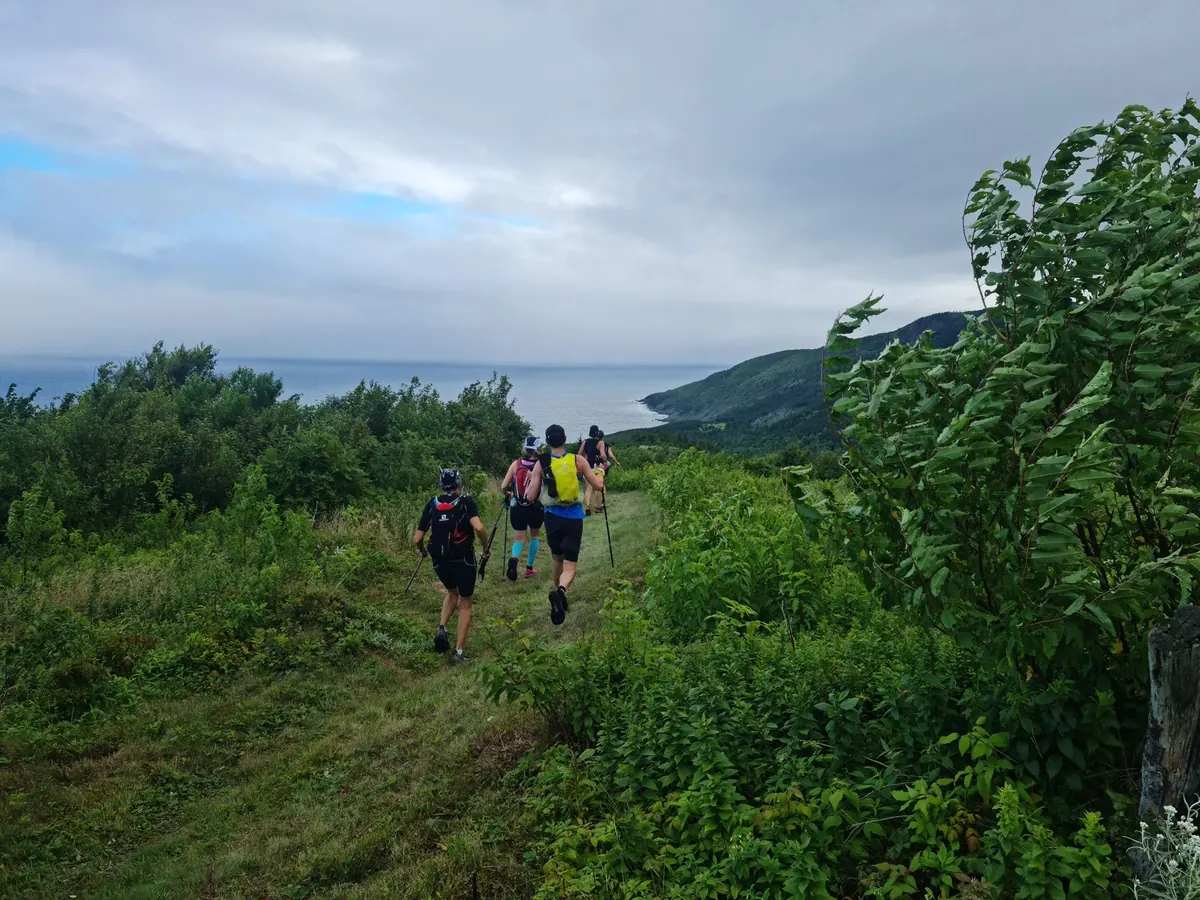
Halfway up a lane, the sign says Porth something and points downhill. Now you know you're heading for a cove, and roughly how the land falls. That small piece of decoding is what turns a walk into an understanding of a place rather than a route between two car parks.
How to make it stick before you arrive
Learn three phrases, not twenty. Dydh da, meur ras, Dyw genes. Say them out loud in the car until they stop feeling foreign, then use each one exactly once on your first day. The rest of the list will attach itself to those three as you hear them around you.
- Don't announce that you're learning Cornish. Just use it.
- Expect an English reply, and don't read anything into it. It's habit, not rejection.
- If someone answers you in Cornish, smile and carry on — you've just had a real conversation.
- Language organisations in Cornwall run classes and publish beginners' material, and short Cornish broadcasts and podcasts are easy to find if you want to hear the rhythm rather than guess at it.
Cornish rewards a light touch. A greeting offered without ceremony, a thank-you said like you mean it, a place name read correctly on a sign — that's the whole point. You're not performing. You're just saying hello in the language of the place you've come to.
Photo: pikabum / Pixabay