Ask four Cornish people how to build a cream tea and you will get four answers, all delivered with total certainty. Ask the same question in Devon and you will get a slightly different four answers. The two counties have been arguing about one small detail for the better part of a century, and the argument shows no sign of cooling. It sounds trivial until you are sitting in a harbour tearoom with a warm scone in front of you and a Devon friend watching your every move.
Here is what actually separates the two traditions, where the split comes from, and how to order on either side of the Tamar without causing a scene.
What a cream tea actually is
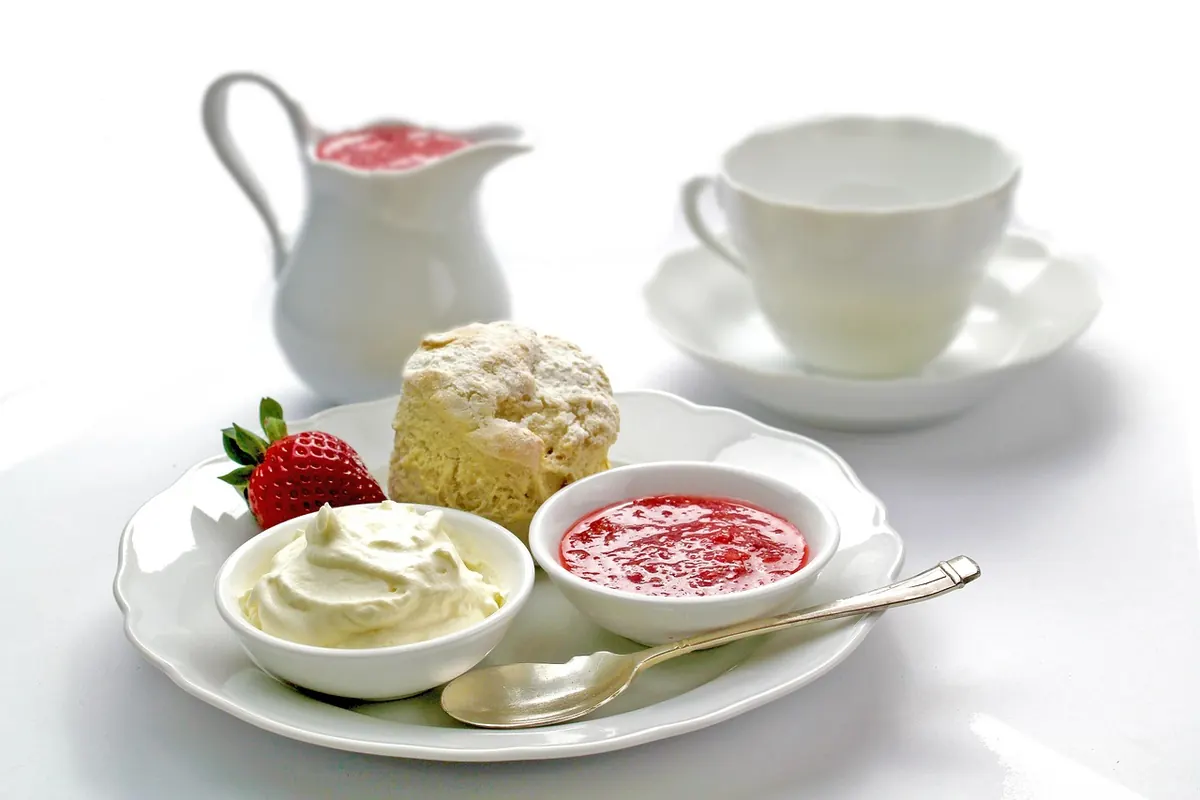
A cream tea is a small, fixed ritual, not an afternoon tea with sandwiches and cakes. Four things belong on the table: a scone or a Cornish split, strawberry or raspberry jam, clotted cream, and a pot of tea. Everything else is a different meal. Prosecco, a slice of Victoria sponge, a ham sandwich — lovely, but not this.
Note the word clotted. Squirty cream from a can, whipped double cream, or anything described as "cream substitute" has no place in the discussion. Clotted cream is baked or scalded, faintly nutty, thick enough to stand in a ridge on a spoon, and the single biggest reason a cream tea tastes like a cream tea rather than a scone with toppings.
The Cornish way: jam first
In Cornwall, the order is jam, then cream. You split or break the scone, spread a decent layer of jam across the surface, and spoon a generous mound of clotted cream on top. The cream is treated as a finishing element, closer to a garnish than a spread.
Cornish splits suit this perfectly. They are soft, slightly sweet yeast buns, milder than a scone, and they hold a layer of jam without crumbling apart. If a tearoom offers you a choice between a split and a fruit scone, take the split at least once. It is the version that grew up alongside the cream.
Jam first, cream on top. Anything else is a Devon debate.
The Devon way: cream first
In Devon, the cream goes down first, spread across the cut scone the way you would butter a slice of bread. The jam goes on top of it. Devonian reasoning is structural: the cream forms a base, the jam finishes the job, and the whole thing holds together on the way to your mouth.
Practically speaking, the Devon method gives you a more even bite. Every mouthful carries cream and jam in roughly the same proportion. The Cornish method gives you the pleasure of a cold, thick cap of cream against warm scone, with jam underneath doing quieter work. Both are good. Only one is correct, depending on which county you are standing in.
Why the two counties disagree
Nobody has a decisive answer, and anyone who tells you otherwise is repeating something they heard in a pub. What you will hear instead are several reasonable theories:
- Jam as a butter substitute. When butter was scarce or expensive, jam went on the scone first, and cream — being a local, plentiful luxury — went on top.
- Cream as a topping. Cornish kitchens tended to treat clotted cream as the star, so it sat on the surface where you could see it and taste it first.
- Two dairy traditions, one argument. Both counties produced clotted cream, both sold it in their own style, and both built a local identity around it.
- Marketing. The rivalry got sharper as tourism grew. A firm rule is easier to sell than a shrug.
The border is the Tamar, and so is the custom. West of the river, jam first. East of it, cream first. That is about as clean as the geography gets.
Cream quality matters more than the order
If you take one thing from all of this, take it here. The order of operations is a matter of taste. The cream is a matter of quality.
A cream tea made with proper Cornish clotted cream, a fresh scone still warm from the oven, and a decent pot of tea will beat a perfect-technique cream tea made with tired cream and a supermarket scone every single time. Look for a thick, pale-yellow crust on the cream surface. Ask when the scones were baked — the answer should be "this morning" or, better, "half an hour ago". Check that the jam tastes of fruit rather than sugar syrup.
Tea matters too. Loose leaf is a bonus, but a proper pot with enough leaves for the number of cups is the real test. Add milk after pouring, unless you are in a house where they insist otherwise, in which case defer politely.
Where to try both
You do not need a famous tearoom, and in summer a famous one often means a queue down the street. What you want is a short menu, a pot of tea, and a view.
- Cornwall: Padstow, St Ives, Mousehole, Boscastle, Fowey and Looe all have harbour-side cafés doing a confident jam-first cream tea. National Trust properties and farm shops inland are often just as good and quieter.
- Devon: Chagford and Widecombe-in-the-Moor on Dartmoor, plus Totnes, Salcombe, Lynton and Clovelly, are reliable territory for the cream-first version, especially in village tearooms with a garden.
- Somewhere in the middle: order one of each, split them with whoever you came with, and compare properly rather than arguing from memory.
How to order without offending anyone
- Ask how the kitchen serves it. Almost every tearoom does it their county's way, and they will tell you with some pride.
- Do not request the other county's order in a small family-run tearoom unless you enjoy being teased for the rest of the meal.
- Share one cream tea between two if you have lunch plans. Portions are generous, and a two-scone cream tea is a full meal.
- Ask for extra cream. It is a fair request, and the standard pot of cream rarely stretches across two scones.
- Go before noon or after three. Between roughly twelve and two, every tearoom in Cornwall and Devon is full.
- Take cash as well as a card. Small seasonal places sometimes have unreliable signal.
So which order should you choose?
Follow the county you are in. It is the easiest rule, it keeps the peace, and it means you taste the tradition where it grew up. In Cornwall, jam then cream. In Devon, cream then jam.
At home, do whatever you like — but put more cream on than feels sensible, warm the scones, and use a proper pot of tea. The argument is half the fun. The other half is eating, and the sooner you stop theorising and start spreading, the better.
Photo: Holgi / Pixabay